



In high-volume, multi-process turning, non-cutting time is a primary detractor from overall equipment effectiveness. Tool change latency compounds significantly over long, complex production runs. Traditional hydraulic or mechanical turrets introduce indexing delays, mechanical wear, and thermal inconsistencies. These issues compromise both cycle times and part tolerance on a heavy duty CNC lathe. Transitioning to a servo-driven indexing system addresses these bottlenecks directly. This guide evaluates the mechanical realities, performance metrics, and operational trade-offs of integrating servo turret technology into modern machining workflows. We will examine how high-speed indexing changes the way shops handle multi-process turning, focusing on cycle time reduction and mechanical rigidity.
Cycle Time Reduction: Servo motors enable sub-second, bidirectional indexing, drastically reducing non-cutting time in complex part programs.
Positional Accuracy: Direct-drive servo mechanisms eliminate the backlash and thermal drift associated with hydraulic fluid, ensuring higher repeatability on any precision turret turning machine.
Application Specificity: While power turrets are necessary for extensive live-tooling and rotary machining, dedicated servo turrets maximize throughput and reliability for standard turning and batch production.
Maintenance & Energy Shift: Replacing hydraulic systems with servo drives lowers fluid maintenance and energy costs, but requires specialized electrical troubleshooting capabilities.
The Mechanics of a Servo Turret Lathe vs. Traditional Systems
Hydraulic vs. Servo Turret Actuation
Understanding the mechanical differences between turret systems is critical for optimizing production on the shop floor. Hydraulic turrets rely on fluid-driven indexing. They use a central pump to push hydraulic oil through valves, manifolds, and cylinders. This fluid motion physically unclamps, rotates, and reclamps the turret head. The viscosity of hydraulic fluid changes as the machine warms up during a shift. This temperature fluctuation causes inconsistent indexing times and requires operators to monitor the system constantly.
In contrast, a servo turret lathe utilizes programmable electric motor drives. A dedicated AC servo motor connects directly to the turret mechanism, often through a precision gearset or direct drive. It uses digital feedback from an absolute encoder to control rotation precisely. There is no fluid to heat up, no valves to stick, and no pressure drops to troubleshoot. The electrical system provides instant torque, moving the heavy turret disk exactly where it needs to go without hesitation.
Indexing speeds highlight a massive performance gap between the two technologies. Hydraulic systems often require two to three seconds to complete a single tool change. The fluid must pressurize, actuate the mechanical cam, rotate the disk, and settle back into the locking coupling. Servo indexing transitions happen in fractions of a second. The electric motor accelerates and decelerates almost instantly. This rapid movement eliminates sluggish tool changes during complex cycles, keeping the spindle cutting metal rather than waiting on the machine.
Energy efficiency gaps also favor electric actuation. Hydraulic power units draw continuous power. The pump runs constantly to maintain system pressure, regardless of whether the turret is indexing or sitting idle during a long threading pass. A servo system features an on-demand energy profile. It only draws peak current during the actual indexing phase. During cutting operations, the servo motor remains idle, consuming negligible power. Eliminating hydraulic power units reduces the overall floor space required for the machine. Shop noise drops significantly without a constantly running pump, and facilities avoid hydraulic fluid disposal requirements.
Servo Turret vs. Power Turret: Defining the Scope
Defining operational boundaries helps in selecting the right equipment for your specific parts. Servo turrets are optimized specifically for rapid tool changes in static turning operations. They excel at quickly presenting fixed cutting tools—like roughing inserts, boring bars, and threading tools—to the workpiece. Their design prioritizes speed, simplicity, and extreme repeatability. Because they do not have internal drive shafts for live tooling, the turret disk is lighter. This lower mass allows the servo motor to index the turret at maximum velocity.
Power turrets, often called live tooling turrets, serve a different purpose. They support milling, drilling, and rotary machining directly on the lathe. To achieve this, they incorporate internal drive mechanisms, bevel gears, and bearings to spin the tools. This added functionality comes with mechanical trade-offs. Power turrets carry higher mass and mechanical complexity. Their pure-indexing speeds are generally slower than dedicated static servo turrets because the motor must rotate a heavier, more complex assembly.
Production managers must weigh these factors carefully when specifying a machine. You should specify a standard servo turret for high-volume turning with minimal secondary operations. Invest in a power turret when parts require extensive off-center drilling, cross-tapping, or milling. Standard turning ratios and batch sizes dictate this choice. If 90% of your work is pure turning, a power turret will only slow down your cycle times and introduce unnecessary maintenance points.
| Feature | Servo Turret (Static) | Power Turret (Live Tooling) | Hydraulic Turret |
|---|---|---|---|
| Primary Application | High-speed static turning | Turning and rotary milling | Standard turning |
| Indexing Speed | Extremely Fast (0.15s - 0.5s) | Moderate (0.5s - 1.0s) | Slow (1.5s - 3.0s) |
| Mechanical Complexity | Low | High | Medium (Fluid based) |
| Turret Disk Mass | Lightweight | Heavy | Medium |
| Maintenance Focus | Electrical/Encoder | Gears/Bearings/Electrical | Fluid/Seals/Pumps |
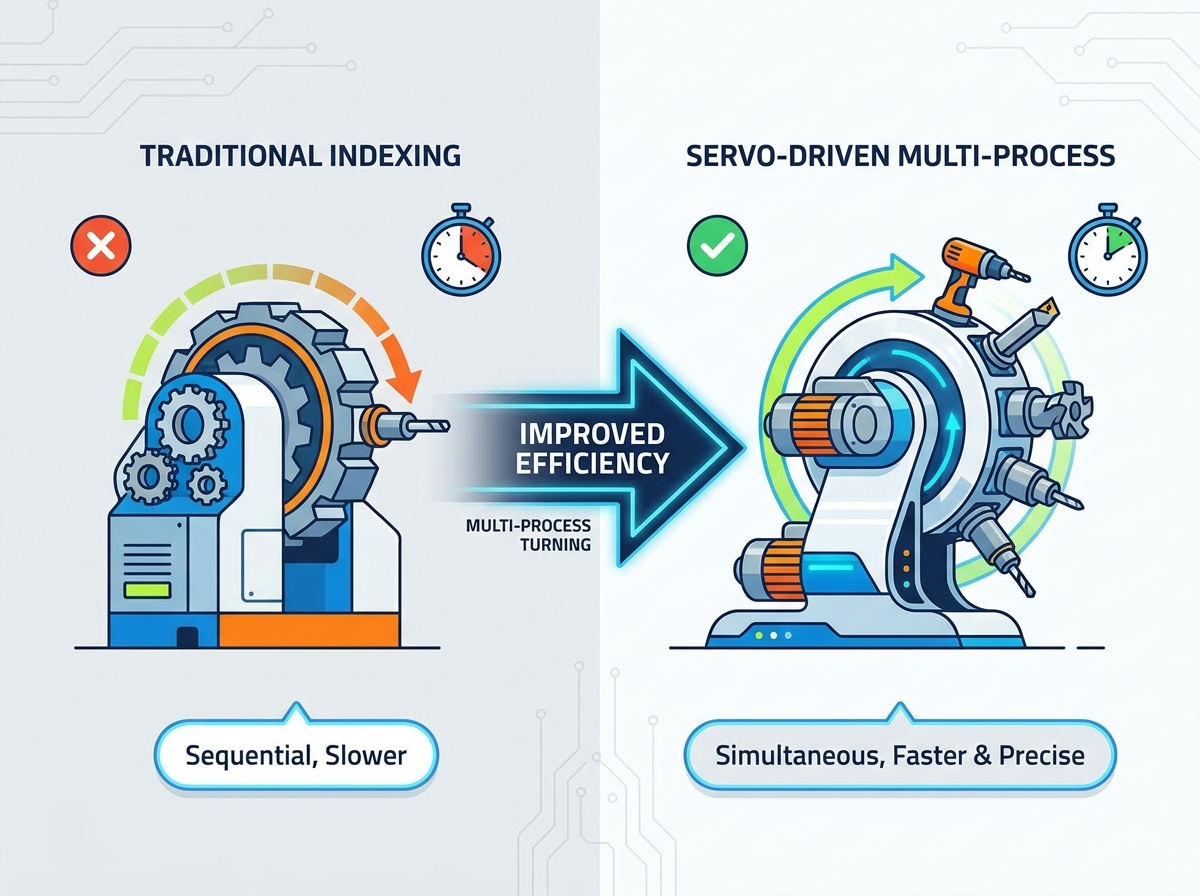
Core Performance Advantages in Multi-Process Turning
Sub-Second Indexing and Bidirectional Logic
Servo drives calculate the shortest path to the next tool station automatically. This bidirectional indexing logic changes how programmers approach tool layouts. If the current tool is at station one and the next is at station ten on a twelve-station turret, the turret rotates backward. It moves two positions instead of rotating forward through eight stations. This intelligent routing minimizes travel distance and time. Hydraulic turrets often rely on unidirectional Geneva mechanisms, forcing the turret to take the long way around.
Part programs dictate the actual time savings on the floor. Programs with high-frequency tool changes benefit exponentially from servo technology. Consider a cycle involving facing, roughing, semi-finishing, grooving, threading, and final finishing. A simple two-tool cycle sees minor gains. A complex multi-tool cycle sees massive reductions in non-cutting time. When you are running a bar feeder and dropping a part every forty seconds, shaving three seconds off the tool changes increases your daily output significantly.
Quantifying this impact reveals substantial production increases. Saving just 1.5 seconds per tool change adds up quickly. If a part requires six tool changes, you save nine seconds per part. On a 10,000-part production run, that equals 90,000 seconds. That is 25 hours of reclaimed machine time. This directly increases throughput without altering cutting feeds, speeds, or depth of cut. You get more parts out the door simply by moving the tools faster.
Absolute encoders play a vital role in this efficiency. They maintain turret position data even when power is lost to the machine. The CNC control knows exactly which tool is active upon startup. You do not need to perform a manual zero-return sequence after an emergency stop or a power outage. The operator simply clears the alarm, resets the program, and resumes cutting. This feature gets the machine back into production faster and prevents accidental crashes caused by calling the wrong tool offset.
Enhancing the Precision Turret Turning Machine
Locking mechanisms define the final accuracy of the turret. Servo turrets utilize high-precision curvic or Hirth couplings. These interlocking gear rings mesh together to lock the turret in place. Once the servo motor indexes the head to the correct position, a heavy-duty clamping mechanism engages these couplings. The teeth wedge together, providing a rigid, perfectly aligned mechanical lock. The servo motor does not hold the tool during the cut; the mechanical coupling does.
Repeatability metrics rely heavily on closed-loop servo feedback. The absolute encoder constantly verifies the exact rotational position before the clamping mechanism engages. This ensures the tool center height remains exact across thousands of continuous cycles. You can trust a precision turret turning machine to hold tight tolerances shift after shift. When turning tight-tolerance bearing journals, even a ten-thousandth of an inch deviation in tool center height will cause diameter variations and chatter.
Thermal stability is another major advantage of electric indexing. Hydraulic fluid heats up during continuous operation, especially in high-cycle applications. This heat transfers directly into the machine casting, causing thermal expansion. Thermal drift forces operators to constantly adjust tool offsets throughout the day to keep parts in tolerance. Servo turrets eliminate this heat source. The machine casting remains stable, preserving tight dimensional tolerances from the morning warmup to the end of the night shift.
Modern CNC controllers integrate smart machining features directly with the servo drive. They utilize drive-level torque monitoring during indexing. If the turret encounters an obstruction—like a long boring bar hitting the tailstock—the torque spikes instantly. The controller detects this spike and halts movement before mechanical damage occurs. This prevents catastrophic collisions, protects the coupling mechanisms, and saves thousands of dollars in replacement parts.
Evaluating the Impact on Heavy Duty CNC Lathe Operations
Rigidity and Clamping Force Realities
Many machinists express skepticism regarding electric turrets. They wonder if an electrically driven turret can withstand high cutting forces. Heavy metal removal requires immense rigidity. The key is understanding how these turrets lock into place. The servo motor is only responsible for positioning the turret disk. It is completely isolated from the cutting forces.
Servo turrets separate the indexing and clamping functions. High-force hydraulic or pneumatic clamping mechanisms engage after the servo indexes the turret. They pull the Hirth coupling together with massive force, often exceeding several tons of clamping pressure. This ensures maximum rigidity during heavy metal removal. The interlocking teeth of the coupling distribute the cutting load evenly across the turret housing, preventing any deflection or vibration from reaching the servo motor shaft.
This design excels in heavy interrupted cuts. Machining tough, aerospace-grade alloys like Inconel 718, titanium, or hardened 4340 steel generates extreme vibration. When a roughing insert hits an interrupted cut, the shock loads are tremendous. The mechanical coupling absorbs these forces. The robust clamping allows the lathe to perform aggressive roughing passes, utilizing the full horsepower of the spindle without compromising the turret's internal components.
Scalability for Continuous Batch Production
Continuous batch production demands high endurance from every machine component. Servo motors thrive in 24/7 lights-out manufacturing environments. They do not suffer from fluid degradation, filter clogs, or pressure drops over long shifts. Their performance remains consistent from the first part to the ten-thousandth part. When paired with a bar feeder and a parts catcher, a servo turret lathe can run unattended for hours, maximizing spindle uptime.
Mechanical wear components are significantly reduced compared to older designs. Traditional turrets rely on cams, Geneva mechanisms, and internal fluid seals to operate. These parts wear down, require lubrication, and eventually fail. Servo systems eliminate these complex mechanical linkages. The direct-drive nature of the servo motor means fewer moving parts. This reduction in mechanical complexity drastically improves the mean time between failures.
Predictable reliability allows for better production scheduling. You can confidently run large batches unattended. The machine will not stop due to a blown hydraulic seal or a jammed Geneva mechanism. This scalability is essential for modern, high-efficiency manufacturing facilities that rely on tight delivery schedules and minimal machine downtime.
Implementation Risks and Operational Savings
Capital Expenditure vs. Operational Savings
Upgrading to servo turret technology requires evaluating the initial machine specification against long-term operational savings. While machines equipped with servo turrets may carry a different initial footprint than basic hydraulic models, the return on investment is realized through cycle time reduction. Faster indexing means more parts per hour. When calculating the payback period, shops must factor in the exact seconds saved per part, multiplied by the annual production volume.
Energy savings also play a role in the operational calculation. Hydraulic power units consume electricity continuously, generating heat that must be managed by the facility's HVAC system. Servo turrets only draw power during the fraction of a second it takes to index. Over a multi-year lifespan, this reduction in electrical consumption lowers the overhead burden of the machine. Furthermore, the elimination of hydraulic oil purchases, filter replacements, and hazardous waste disposal fees contributes to a leaner operating budget.
Maintenance Profiles and System Compatibility
Adopting servo technology shifts the maintenance profile of your shop. You move away from messy mechanical and fluid troubleshooting. There are no hydraulic leaks to trace under the machine. You do not have to worry about seal wear, oil degradation, or cleaning out sludge from the hydraulic tank. The focus shifts to simplified, cleaner maintenance routines.
Maintenance now involves servo tuning and electrical diagnostics. Technicians must understand encoder feedback, drive parameters, and alarm codes. They need to monitor motor temperatures and check electrical connections inside the cabinet. While cleaner, this requires a different skill set from traditional mechanical repair. Shops must ensure their maintenance personnel are comfortable using multimeters and navigating CNC diagnostic screens.
Control system compatibility is absolutely critical when specifying a machine. The servo turret drive must communicate seamlessly with the machine's primary CNC controller. Mixing a Fanuc controller with an incompatible third-party servo drive causes communication latency. This latency negates the speed advantages of the servo turret. Always ensure seamless PLC integration and verify that the machine builder uses matched drive components.
Risk Mitigation and Operator Training
Risk mitigation strategies must focus on operator training. Servo turrets move incredibly fast. Operators must be aware of clearance zones during setup. A crash at servo speeds can severely misalign the turret head. Programmers must ensure that the turret is retracted to a safe home position before commanding an index, especially when using long boring bars or extended drills.
Training must cover specific crash-recovery procedures. Unlike hydraulic turrets, servo turrets require specific realignment protocols after a physical collision. Operators must know how to unclamp the coupling manually. They need to reset the grid shift parameters in the CNC control to realign the tools to the spindle center. Proper training minimizes downtime after an accidental crash, allowing the shop to get the machine cutting metal again quickly.
Routine inspections remain necessary to maintain accuracy. Operators should verify the clamping coupling for chip ingress. Chips caught in the Hirth teeth will prevent proper seating. This causes immediate tolerance issues and can damage the coupling over time. Keeping the coupling area clean, ensuring the coolant flush is working, and verifying the mechanical clamping pressure ensures long-term accuracy and reliability.
Conclusion
A servo turret is the definitive choice for manufacturers prioritizing speed and repeatability. It drastically reduces non-cutting time in standard turning and multi-process batch production. By eliminating hydraulic delays and thermal drift, these systems elevate overall machining efficiency. Transitioning to this technology requires an understanding of the mechanical differences, but the operational benefits far outweigh the learning curve.
Conduct a cycle-time analysis on your current high-volume parts using CAM software to simulate the exact time savings a servo turret upgrade will yield.
Audit your shop's maintenance capabilities to ensure technicians can handle electrical diagnostics, encoder troubleshooting, and servo tuning.
Establish strict crash-recovery protocols and train all operators on grid shift realignment procedures to minimize downtime.
Verify CNC controller compatibility and drive integration before finalizing any new machine specification.
FAQ
Q: What is the average indexing time of a servo turret lathe?
A: Industry benchmarks show servo turrets typically index from one station to the adjacent station in 0.15 to 0.5 seconds. This rapid movement drastically reduces non-cutting time compared to traditional hydraulic systems, which can take up to three seconds.
Q: Can a servo turret handle heavy interrupted cuts?
A: Yes. The servo motor handles rapid rotation, but robust mechanical couplings handle the actual clamping. This separation of duties makes them highly capable of heavy-duty machining on a heavy duty CNC lathe without damaging the motor.
Q: How does a servo turret differ from a power turret?
A: A servo turret uses a servo motor for rapid indexing of static turning tools. A power turret includes internal drive mechanisms and gear trains to spin live tools, like end mills and drills, for milling processes.
Q: What maintenance is required for a precision turret turning machine?
A: Routine checks include verifying encoder feedback, inspecting the clamping coupling for chip ingress, monitoring servo motor temperatures, and ensuring the mechanical clamping pressure remains within specification.
Q: How does the energy consumption of a servo turret compare to a hydraulic turret?
A: Hydraulic turrets require continuous pump operation to maintain system pressure. Servo turrets consume negligible standby power. They only draw significant energy during active indexing, making them much more energy-efficient.
Q: Is it possible to retrofit a hydraulic lathe with a servo turret?
A: While technically possible, retrofitting involves severe CNC control and PLC integration challenges. Purchasing a new machine or an OEM-supported upgrade is usually more viable and reliable.
Q: How does bidirectional indexing improve CNC cycle times?
A: The CNC control automatically rotates the turret in the direction of the shortest path to the next tool. This eliminates unnecessary full rotations, shaving valuable seconds off complex part programs.
Related Articles
-
 Dear Customers and Business Partners,In order to strictly comply with national export control laws and regulations, and to fulfill international obligations, ensuring that our exported CNC milling machines and CNC lathes are fully legal and compliant, we hereby notify you of the relevant policies coCompany News
 -
 Eliminate part deflection and chatter. Master expert workholding strategies for vertical milling machines to maximize CNC precision and reduce scrap.Product news
 -
 Stop tool breakage and scrap parts. Discover how horizontal milling machines use gravity for flawless chip evacuation and maximum ROI.Product news


