



Purchasing capital equipment involves high stakes on the shop floor. Selecting the wrong machine leads to immediate production bottlenecks, excessive tooling wear, and stranded capital that could have been deployed elsewhere. Navigating manufacturer spec sheets often obscures real-world performance. You must balance spindle speed, machine rigidity, and axis configuration across different workshop scales to make the right choice for your specific production runs.
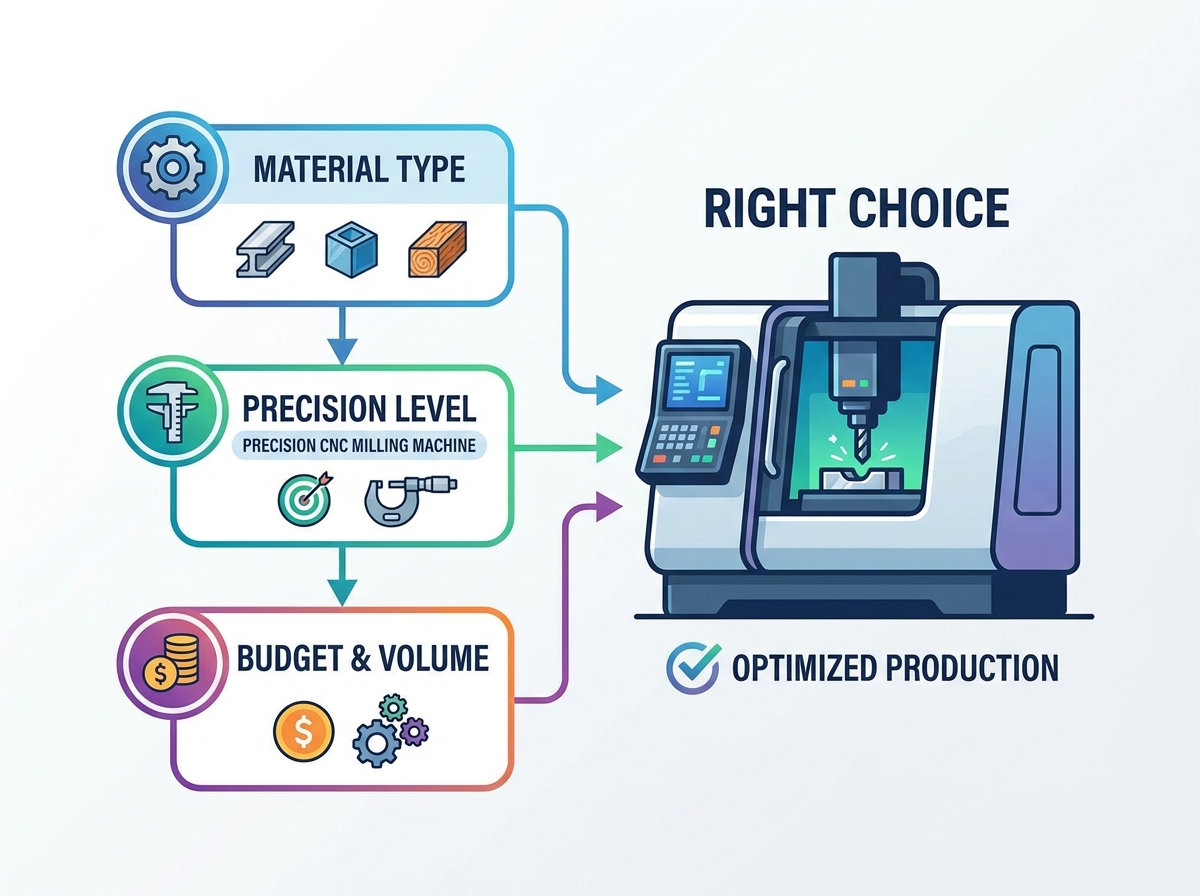
A systematic evaluation framework is required to move beyond basic footprint dimensions. You must assess material requirements, facility constraints, and control ecosystems before signing a purchase order. This guide provides the technical insights needed to evaluate and select the right CNC Milling Machine for your specific production goals, ensuring you match the iron to the application.
Match Rigidity to Material: Machine mass and spindle taper dictate success with hard alloys; high RPM is secondary to torque and dampening for tough materials.
Align Machine Class with Business Goals: Define whether you need an entry-level toolroom mill for prototyping, a versatile shop-floor unit, or a high-volume production-grade CNC milling machine.
Axis Configuration Drives Throughput: Upgrading from 3-axis to 4- or 5-axis configurations drastically reduces setup times and tolerance stacking on complex parts.
Facility Readiness is Non-Negotiable: Floor loading, 3-phase power availability, and ceiling clearance must be audited before shortlisting models.
TCO Exceeds Base Price: Workholding, tooling, rigging, and preventative maintenance often add 20-30% to the initial capital expenditure.
Defining Your Core Production Requirements
Defining the Primary Machine Goal
Establish the primary objective before evaluating specifications. Determine if you intend to cut simple prototype parts, produce custom manufacturing fixtures, or run continuous high-volume production. The intended application dictates the necessary speed, automation features, and structural class of the required equipment. A job shop requires versatility and quick changeovers, often relying on conversational controls and flexible workholding like modular vises. A dedicated OEM production facility prioritizes automation, pallet changers, and aggressive chip evacuation systems to keep the spindle turning continuously.
An R&D lab might prioritize precision and flexibility over raw throughput, opting for a highly accurate machine with glass scales rather than a heavy-duty roughing mill. You need to look at the parts you plan to make over the next five years, not just the parts you are making today. If your goal is to machine aerospace components, you will need a machine built for tight tolerances and complex geometries. If you are making brackets for agricultural equipment, raw material removal rates and heavy castings will take precedence over micron-level positioning.
Material Hardness and Machinability
Target materials dictate machine architecture. Cutting aluminum or plastics requires high spindle RPM and rapid feed rates to maximize material removal. You want a spindle that can hit 12,000 to 15,000 RPM to maintain proper chip loads with small diameter end mills. Conversely, machining titanium, Inconel, or tool steel demands high low-end torque, box ways, and heavy cast-iron mass for vibration dampening. High RPM is useless if the spindle stalls when a 3-inch face mill engages a block of 4140 steel.
Machine rigidity directly correlates with extended tool life when operating a precision CNC milling machine. Insufficient rigidity causes chatter, which rapidly degrades cutting edges, chips carbide inserts, and compromises surface finish. Heavy castings absorb harmonic vibrations generated during heavy interrupted cuts. When you are roughing out a hardened steel forging, the mass of the machine frame is the only thing keeping the cutting tool stable.
| Material Type | Spindle Requirement | Guideway Preference | Coolant Need |
|---|---|---|---|
| Aluminum / Plastics | High RPM (12k+) | Linear Guides | Standard Flood |
| Mild Steel / Cast Iron | Medium RPM, Good Torque | Linear or Box Ways | Flood / Air Blast |
| Titanium / Inconel | High Torque, Low RPM | Box Ways | High-Pressure TSC |
| Hardened Tool Steels | High Torque, Rigid Spindle | Box Ways | High-Pressure TSC |
Part Complexity, Size, and Production Volume
Define the required work envelope based on maximum part dimensions. The largest component you plan to machine dictates the necessary X, Y, and Z-axis travel. Ensure adequate clearance for tool changes and workholding fixtures within this envelope. A common mistake is buying a machine with exactly enough travel for the part, forgetting that a 6-inch drill bit and a 4-inch tall vise will consume 10 inches of your Z-axis clearance before you even start cutting.
Analyze production volume to determine necessary features. High-mix, low-volume environments prioritize ease of setup. You will want features like wireless intuitive probing systems to set work offsets quickly. Low-mix, high-volume production runs require robust chip evacuation systems, automatic pallet changers, and high-capacity tool magazines. If you are making 10,000 identical parts, saving 10 seconds per cycle through faster tool changes or better chip flushing translates to massive gains in throughput.
Tolerance and Precision Standards
Establish when a standard mill is sufficient versus when a high-accuracy machine is strictly required. Standard mills handle general tolerances suitable for most commercial applications, typically holding +/- 0.001 inches without much trouble. Aerospace or medical components often require a high-accuracy machine capable of holding micron-level tolerances across the entire work envelope, day in and day out.
Maintaining tight tolerances over long production shifts requires specific thermal management features. Thermal growth impacts accuracy as spindle and axis motors generate heat, causing the cast iron frame to expand and shift the tool position. Linear scales provide direct position feedback, compensating for ball screw expansion by reading the actual position of the table rather than relying on motor encoder counts. Chilled ball screws actively manage temperature by pumping coolant through the core of the screw to maintain consistent precision during aggressive, high-speed machining cycles.
Evaluating CNC Milling Machine Configurations and Types
Benchtop, Knee, and Toolroom Mills vs. Industrial Machining Centers
Benchtop and compact mills offer small-footprint solutions for garages and light-duty prototyping. They operate on standard power but possess severe limitations in material removal rates and structural rigidity. They struggle with hard metals and aggressive cutting parameters. If you try to push a half-inch end mill through steel on a benchtop machine, the entire frame will flex, resulting in terrible surface finishes and broken tools.
Knee mills and manual-to-CNC retrofits serve well for secondary operations and simple repair work. They handle low-complexity components effectively and are great for squaring up stock or drilling simple bolt hole patterns. However, transitioning to enclosed industrial machining centers becomes necessary to sustain profitable throughput and implement automated production workflows. Enclosed machines contain the coolant splash, manage chips automatically, and provide the rigidity needed for modern high-speed dynamic milling toolpaths.
Vertical Machining Centers (VMCs) vs. Horizontal Machining Centers (HMCs)
Vertical Machining Centers (VMCs) dominate general part manufacturing due to lower entry costs and smaller footprints. They offer straightforward setup and programming, as the operator looks directly down at the table. However, VMCs face limitations in chip evacuation when machining deep pockets, as gravity pulls chips back into the cut. Recutting chips destroys end mills and ruins surface finishes.
Horizontal Machining Centers (HMCs) excel in high-volume production environments. Their spindle orientation allows natural gravity-assisted chip evacuation, as chips fall away from the workpiece. HMCs inherently support tombstone fixtures and pallet pools, maximizing spindle uptime and enabling continuous production cycles. While an operator loads parts on one pallet outside the machine, the spindle is cutting parts on the other pallet inside the machine.
Evaluate your floor space: HMCs require significantly more square footage than VMCs.
Analyze your part geometry: Deep pockets favor HMCs for chip clearing.
Assess your production volume: High volume justifies the HMC investment through increased spindle uptime.
Review your workholding budget: Tombstones and modular fixturing for HMCs require a larger upfront investment.
3-Axis vs. 4-Axis vs. 5-Axis Capabilities
A 3-axis configuration is best for flat, prismatic parts. It offers the lowest cost and easiest programming. The cutting tool moves along the X, Y, and Z axes, making it suitable for plates, brackets, and simple enclosures. Adding a rotary table or indexer creates a 4-axis machine, allowing cylindrical work and multi-sided machining without manual refixturing. This is excellent for machining features on the circumference of a shaft or working on multiple sides of a block in a single setup.
A 5-axis machine, whether indexed 3+2 or full simultaneous, reduces setup times significantly. It eliminates tolerance stacking associated with manual refixturing. Every time an operator unclamps a part and flips it over, a small amount of error is introduced. Machining five sides of a part in one setup eliminates this error. Simultaneous 5-axis machining is essential for generating complex organic geometries, such as aerospace impellers, turbine blades, and complex mold cavities where the tool must remain normal to the surface at all times.
Gantry and Bed Mills
Gantry and bed mills provide large-format solutions for oversized components. They handle aerospace panels, large molds, and heavy castings that would crush the linear guides of a standard VMC. In a bed mill, the table only moves in the Y-axis, while the spindle head handles X and Z movements. In a gantry mill, the table remains completely stationary, supporting massive part weights, while the cutting head traverses a bridge structure overhead. This design provides immense rigidity for heavy material removal on massive workpieces.
Critical Technical Specifications to Compare
Spindle Speed, Torque, and Taper Size
Spindle taper standards dictate tooling compatibility and cutting capability. CAT40 or BT40 tapers serve as the standard for general industrial applications, offering a good balance of speed and rigidity for most aluminum and mild steel jobs. CAT50 tapers provide the massive rigidity required for heavy material removal in tough alloys. The larger flange and longer taper provide significantly more surface contact, preventing the tool holder from deflecting under heavy side loads. HSK tapers excel in high-speed, high-precision applications because they expand as spindle speeds increase, gripping the tool holder even tighter.
Analyze the power curve rather than relying solely on peak horsepower. Peak horsepower is a misleading metric often used in marketing brochures. Continuous torque at specific RPM ranges determines the machine's ability to push large cutters through tough materials without stalling. A machine might boast 30 horsepower at 10,000 RPM, but if it only produces 20 foot-pounds of torque at 1,000 RPM, it will struggle to drive a large face mill or a heavy U-drill through steel.
Machine Rigidity and Guideway Design
Guideway design impacts speed and rigidity. Linear Guide Ways offer high speed and lower friction, making them ideal for aluminum and light steel where rapid traverse rates reduce cycle times. They utilize recirculating ball bearings on precision rails. Box Ways provide superior vibration dampening, essential for heavy interrupted cuts and exotic alloys. Box ways consist of solid cast iron surfaces sliding against each other, separated by a thin film of way lube. They are slower but offer unmatched rigidity.
The machine's casting material influences harmonic dampening. Meehanite cast iron provides excellent vibration absorption, ensuring stable cutting conditions. Polymer concrete offers superior thermal stability and dampening characteristics, often found in high-end precision machines. The overall weight of the machine frame directly correlates with its ability to maintain stability during aggressive machining. A 15,000-pound machine will inherently handle heavy cuts better than a 7,000-pound machine of the same physical dimensions.
Tool Capacity and Automatic Tool Changers (ATC)
Evaluate ATC styles and their impact on chip-to-chip times. Umbrella-style changers are common on entry-level machines but are generally slower and expose the tool tapers to coolant and chips. Side-mount or swing-arm tool changers offer rapid tool changes, minimizing non-cutting time. They stage the next tool while the spindle is still cutting, resulting in chip-to-chip times of just a few seconds.
Calculate required tool magazine capacity based on part complexity. Complex parts require numerous specialized tools, including various end mills, drills, taps, and chamfer tools. Integration of redundant tooling is necessary for lights-out manufacturing. If you are running a machine unattended overnight, you need backup tools in the carousel. When the primary end mill reaches its wear limit, the machine automatically swaps to a fresh identical tool to continue production without operator intervention.
Control Systems, Software Compatibility, and Ease of Use
Compare industry-standard controllers like Fanuc, Siemens, and Heidenhain with proprietary, user-friendly conversational controls. Industry-standard controls offer robust features for complex programming, high-speed look-ahead processing, and macro variable integration. Conversational controls simplify setup for simpler parts and high-mix environments, allowing operators to program directly at the machine without needing a separate CAM station.
Consider the learning curve and operator familiarity. Availability of local machinists trained on specific controls reduces onboarding time. If every machinist in your area knows Fanuc, buying a machine with an obscure control will make hiring difficult. Ensure seamless CAD/CAM software integration, verify post-processor availability, and confirm DNC or network connectivity for efficient program transfer. A machine is useless if your CAM software cannot generate clean G-code that the controller understands.
Facility Constraints and Implementation Realities
Floor Space, Height, and Foundation Requirements
Measure the required maintenance envelope, not just the machine footprint. Account for door swings, coolant tank removal, and electrical cabinet access. You need room to pull the chip conveyor out for cleaning and space for technicians to access the rear panels. Ensure adequate ceiling clearance for Z-axis travel and rigging operations during installation. Forklifts and gantry cranes need overhead room to lift the machine off the shipping skid and place it into position.
Address concrete foundation requirements before installation. Verify minimum slab thickness and load-bearing capacity. Core drilling for anchors may be necessary to secure the machine and prevent it from walking during aggressive rapid movements. Isolation pads prevent external vibrations from affecting precision operations. If your shop is next to a railroad track or a stamping press, you must isolate the milling machine foundation to prevent those vibrations from transferring into your surface finishes.
Utility Requirements: Power and Air
Outline electrical demands accurately. Industrial machines require stable 3-phase power and dedicated breakers. Voltage drops during heavy spindle acceleration will cause alarms and ruin parts. Phase converters may be necessary for residential or light commercial spaces lacking native 3-phase service, but ensure the converter is sized appropriately for the peak amp draw of the machine, not just the continuous load.
Assess compressed air requirements for tool changers, spindle air purges, and pneumatic workholding. Verify CFM and PSI minimums. Air dryers are critical to prevent moisture from damaging internal pneumatic components and spindle bearings. Water in your air lines will wash the grease out of your spindle bearings, leading to catastrophic failure and a massive repair bill. Install a dedicated refrigerated air dryer and inline filtration right at the machine inlet.
Coolant and Chip Management Systems
Evaluate chip conveyor types based on material type. Auger conveyors handle stringy aluminum chips adequately but struggle with heavy steel chips. Hinge belt conveyors are versatile for mixed materials and are the standard for most job shops. Scraper conveyors effectively manage fine cast iron or brass dust that would otherwise slip through the hinges of a belt conveyor and build up in the coolant tank.
Through-Spindle Coolant (TSC) is essential for deep-hole drilling and high-speed machining. TSC flushes chips from deep cavities and cools the cutting edge directly, significantly extending tool life and improving surface finish. Without TSC, drilling deep holes requires constant pecking to clear chips, which drastically increases cycle times. High-pressure TSC systems (300 to 1000 PSI) blast chips out of the hole, allowing for continuous feed rates and massive productivity gains.
Conclusion
Evaluate your target materials and determine the required rigidity and spindle taper before looking at specific models. Audit your facility's power, air, and floor space capacities to ensure you can actually install and run the equipment. Request time studies and test cuts using your actual CAD models to verify real-world performance rather than relying on brochure specifications. Consult with your CAM programmers to ensure seamless software integration and post-processor availability before finalizing a purchase order.
FAQ
Q: What is the difference between a standard and a precision CNC milling machine?
A: A standard machine handles general commercial tolerances. A precision machine utilizes thermal compensation, linear scales, and chilled ball screws to maintain micron-level accuracy over long shifts.
Q: How do I choose a CNC milling machine for a small or home-based workshop?
A: Focus on single-phase power compatibility, compact footprints, and conversational controls. Benchtop or compact toolroom mills are ideal, though they have limitations in material removal rates.
Q: Should I choose a Vertical (VMC) or Horizontal (HMC) milling machine?
A: Choose a VMC for general part manufacturing, lower costs, and ease of setup. Choose an HMC for high-volume production, superior chip evacuation, and pallet pool integration.
Q: What spindle taper is best for heavy material removal?
A: A CAT50 taper provides the massive rigidity required for heavy material removal in tough alloys like titanium or tool steel.
Q: How do I determine if my shop needs a 4-axis or 5-axis CNC mill?
A: If you frequently machine cylindrical parts or require multiple setups for multi-sided parts, a 4-axis or 5-axis machine will reduce setup times and eliminate tolerance stacking.
Q: What is the learning curve for operating and programming a CNC milling machine?
A: Conversational controls are easier for beginners. Industry-standard controls require more training. Proficiency depends on prior machining experience and the complexity of the CAM software used.
Q: How thick does my concrete floor need to be for an industrial CNC mill?
A: Industrial machines typically require a reinforced concrete slab between 6 to 8 inches thick, but always consult the manufacturer's specific foundation requirements for the chosen model.
Related Articles
-
 Dear Customers and Business Partners,In order to strictly comply with national export control laws and regulations, and to fulfill international obligations, ensuring that our exported CNC milling machines and CNC lathes are fully legal and compliant, we hereby notify you of the relevant policies coCompany News
 -
 Understanding which machine tool is best suited for machining which material can assist machining factories and machine tool agents in making the optimal choice. This article introduces the materials that can be most effectively machined by CNC milling machines, CNC lathes, and CNC machining centers.CNC Machine Industry News
 -
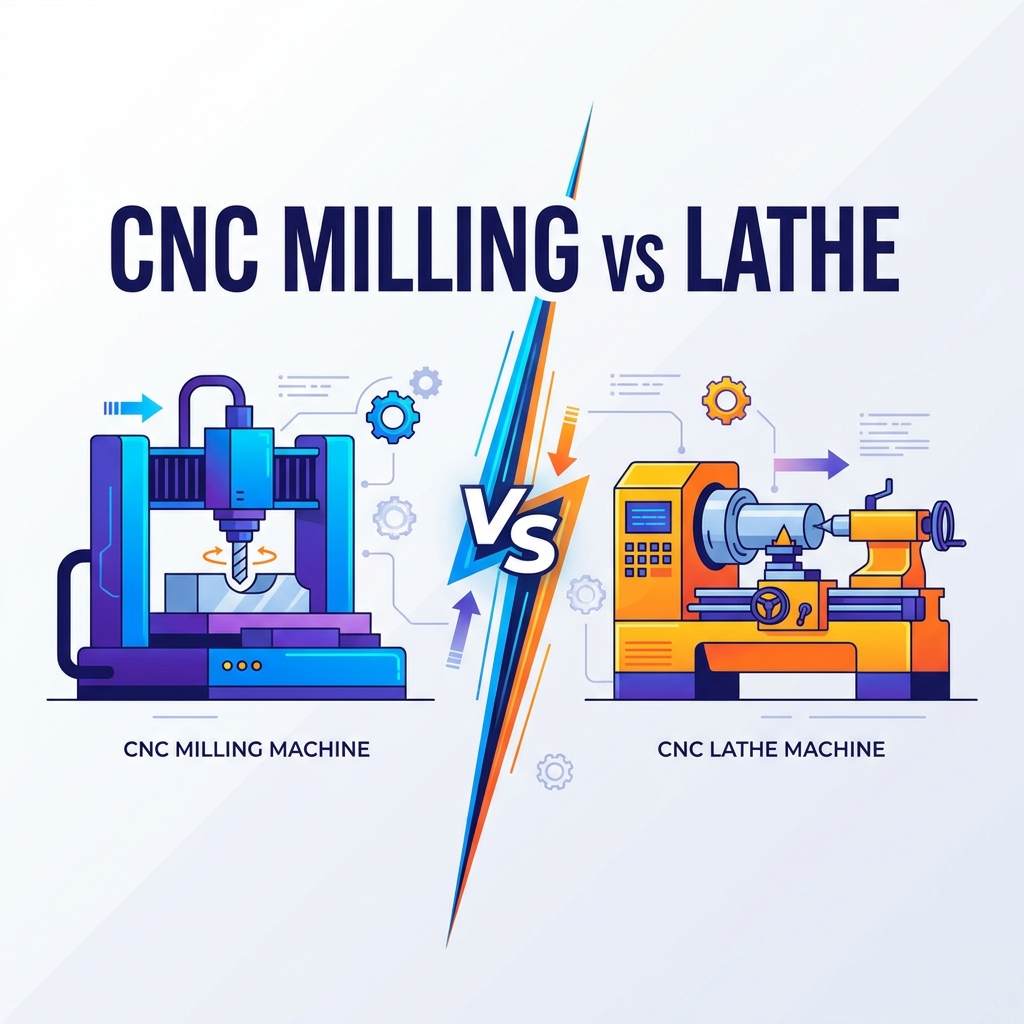 Compare CNC milling vs. turning. Learn differences in kinematics, geometry, cost, and automation to select the right machine for your production.Product news


