



Material selection in CNC turning isn't just about the final part's function—it directly dictates cycle times, tool wear, and whether the project scales profitably. Engineers often focus solely on the end-use requirements of a component. They specify tough alloys for maximum field durability. However, this approach ignores critical manufacturing realities.
While modern equipment can cut almost anything, "can it be turned?" and "can it be turned efficiently?" are entirely different business questions. A highly durable alloy might perform perfectly in the field but bankrupt your machining budget. You need to balance mechanical properties against machining capabilities. An overly hard material destroys tools and extends cycle times.
This guide breaks down how a CNC Turning Machine handles various material classes. We explore the physical risks involved in processing plastics, standard metals, and exotic alloys. You will learn how to align your material choice with production realities and machine capabilities.
Key Takeaways
Metals scale best: Aluminum, brass, and mild steels offer the highest machinability ratings, allowing a CNC turning machine to run at peak RPMs with minimal tool wear.
Plastics require strict thermal management: Materials like Nylon and Acrylic risk melting, deflection, or moisture-induced tolerance shifts without precise feed-rate control.
Exotics demand heavy iron: Titanium and superalloys (Inconel) necessitate high-rigidity turning centers, specialized tooling, and high-pressure coolant due to poor thermal conductivity and work-hardening risks.
Total cost equals material plus time: Cheaper raw materials that require slower cutting speeds often result in higher overall per-part costs than premium, highly machinable alloys.
The Business Economics of Material Selection in CNC Turning
Material choice drives machining economics directly. Every raw stock possesses a distinct machinability rating. Industry standards measure this score against free-machining brass. Engineers assign brass a baseline score of 100%. A high rating means effortless cutting. Lower ratings dictate much slower spindle speeds.
You cannot force equipment through tough alloys quickly. The spindle load will spike immediately. Slower feed rates inflate your cycle times significantly. More time per part increases your direct manufacturing costs. Cycle time directly controls your profit margins. A cheaper but tougher material often costs more overall. The extra machine hours erase the raw material savings entirely.
Tooling cost realities also hide in the background. Tough materials degrade cutting inserts rapidly. Machine operators must stop the spindle frequently. They must swap out dull inserts for fresh ones. This downtime halts your entire production line. You burn through expensive carbide or diamond inserts quickly. Tool changes disrupt dimensional stability. Operators must recalibrate offsets after every tool change.
Scrap and setup variables further affect these economics. Your starting stock shape matters immensely. Using uniform bar stock reduces initial preparation time. Cast blanks might require complex chucking setups. Material consistency dictates your scrap percentage. Irregular raw stock causes severe tool chatter. It ruins surface finishes and leads to rejected parts. Consistent material keeps your setup stable and waste minimal.

Standard Metals: The High-Efficiency Baseline
Standard metals form the backbone of modern manufacturing. They offer predictable results and highly stable cutting forces. A capable CNC Turning Machine processes them extremely efficiently. We rely on these alloys for high-volume production runs.
| Material | Machinability Rating | Relative Tool Wear Rate |
|---|---|---|
| Brass C360 | 100% (Baseline) | Very Low |
| Aluminum 6061 | 90% | Low |
| Mild Steel 1018 | 78% | Moderate |
| Stainless Steel 304 | 45% | High |
Aluminum (6061, 7075, 5052)
Processing aluminum remains highly efficient across the industry. Operators use aggressive depth of cut (DOC) settings. They run spindles at maximum surface speeds. The chips break easily and evacuate quickly. Aluminum 6061 offers excellent stability and rapid material removal. Aluminum 7075 provides higher strength but machines similarly well. Aluminum 5052 feels slightly gummier. It requires sharper tools to prevent built-up edge (BUE).
Engineers specify aluminum for aerospace components and lightweight housings. It delivers tight tolerances without stressing the machine structural components. The heat flows entirely into the chips. The workpiece stays cool and dimensionally accurate.
Brass (e.g., C360 Free-Machining)
Brass sets the standard for machining efficiency. It provides excellent chip control and minimal tool wear. The lead content in C360 acts as an internal lubricant. It causes the chips to fracture instantly. Long, stringy chips never wrap around the chuck. Brass often yields the lowest cycle times of any metal.
Manufacturers use brass extensively for fluid fittings and electrical connectors. The material cuts so cleanly you rarely need secondary finishing. Threading operations perform flawlessly on brass. Tool life can extend for weeks before an insert change becomes necessary.
Carbon & Stainless Steels (304, 316)
Carbon and stainless steels introduce distinct challenges. Alloy 304 is versatile but susceptible to rapid work hardening. If the tool rubs instead of cuts, the surface hardens instantly. You must maintain a continuous feed rate. Pausing the tool will destroy the insert immediately.
Marine-grade 316 stainless contains molybdenum. It resists corrosion better but acts much tougher. It requires sharp tooling and highly consistent feed rates. If you drop the feed rate, the material glazes over. Common use cases include drive shafts, pipe flanges, and medical instruments. A rigid setup is mandatory to prevent vibration.
Engineering Plastics: Navigating Thermal and Structural Risks
Plastics behave entirely differently than metals. You must manage heat continuously during the process. Friction generates localized heat quickly. Plastics possess terrible thermal conductivity. The heat stays trapped directly in the part. This thermal accumulation causes severe dimensional shifting.
Delrin (POM) & PEEK
Delrin (POM) is highly stable and machines cleanly. It acts very similarly to free-machining brass. It produces manageable chips and holds tight tolerances. You can run high spindle speeds safely. PEEK offers incredible mechanical strength. It rivals certain metals in heat resistance.
However, PEEK carries a premium raw material cost. You cannot afford scrap when turning PEEK components. It is also surprisingly abrasive to cutting tools. You must monitor insert wear closely. Dull tools will generate excess heat and smear the surface finish.
Nylon & Acrylic (PMMA)
Nylon presents a very specific implementation risk. It absorbs ambient moisture rapidly. This moisture causes post-machining dimensional expansion. You might turn a nylon part perfectly today. Tomorrow, it swells and fails inspection. You must accommodate this expansion during the design phase.
Acrylic (PMMA) is extremely brittle. It crazes under stress. If the tool pushes instead of shearing, the part shatters. Acrylic is highly prone to melting. If tool geometry and coolant aren't optimized, it melts instantly. The molten plastic welds onto the cutting edge.
Best Practices for Turning Polymers
We recommend specific best practices for turning polymers. You must rethink your entire tooling approach. Metal-cutting tools rarely work well on plastics. You need distinct geometries to prevent surface tearing.
Use highly polished inserts: Polished faces prevent plastic chips from sticking to the tool.
Select high-rake angles: Extremely sharp, positive geometries shear the material cleanly.
Maintain aggressive feeds: Fast feed rates ensure the tool cuts rather than rubs the surface.
Apply chilled air: Air blasts clear chips without introducing chemical solvents. Solvents can degrade certain polymers.
Control clamping force: Soft plastics distort easily under heavy chuck jaw pressure. Use custom soft jaws.
Hardened Alloys & Composites: Testing Machine Limits
Exotic alloys push equipment to absolute limits. They expose any weakness in your machining setup. You cannot cut these materials on light-duty equipment.
Titanium & Superalloys (Inconel)
Processing titanium remains extremely challenging. It possesses very low thermal conductivity. The heat does not escape through the chips. The heat stays trapped directly at the cutting edge. This thermal concentration rapidly destroys standard carbide tools. The material also exhibits a low modulus of elasticity. It tends to spring away from the tool under pressure.
Inconel retains its immense strength at high temperatures. It fights the cutting tool aggressively. This resistance causes severe work-hardening risks. Processing these superalloys demands high-torque spindles. You need rigid box-way machine beds to absorb vibration. A high-end CNC Turning Machine handles these forces effectively. You must also supply high-pressure through-tool coolant. This coolant blasts the heat away directly from the cut zone.
Carbon Fiber Reinforced Polymers (CFRP)
Carbon Fiber Reinforced Polymers introduce extreme abrasive wear. The carbon fibers shred conventional tools quickly. CFRP also carries a high risk of layer delamination. The cutting forces can rip the composite layers apart. Once delamination occurs, the part is completely ruined.
This reality dictates specialized requirements. You must use diamond-coated (PCD) inserts. Diamond withstands the abrasive nature of the carbon fibers. You also need highly controlled feed strategies. You cannot plunge tools aggressively into CFRP. The pressure will separate the internal bonding resin.
Decision Framework: Matching Material to Machine Capabilities
You must match your material to your equipment capabilities. A mismatch guarantees failed parts and broken tools. You should evaluate your resources before purchasing expensive raw materials.
Standard CNC Lathes vs. CNC Turning Centers
Evaluate whether your chosen material and geometry require live tooling. A standard two-axis lathe handles simple cylindrical profiles perfectly. Complex parts require advanced equipment to remain profitable. Modern turning centers feature Y-axis and C-axis capabilities. These axes allow off-center drilling and milling.
By utilizing a turning center, you avoid secondary setups. Moving a tough Inconel part to a separate milling machine introduces setup errors. Completing the part in one machine cycle improves dimensional accuracy. It also reduces total handling time.
Rigidity and Workholding Constraints
Rigidity dictates your machining success. Workholding constraints determine your achievable tolerances. Consider how long, slender parts behave under cutting pressure. Slender shafts will bend away from the tool. Soft plastics deflect easily under side loads.
You must support these parts properly. They require tailstocks or steady rests to prevent deflection. The situation changes entirely for hard turning. Hard turning involves cutting metals exceeding 45 HRC to replace traditional grinding. This process requires top-tier machine rigidity. Any structural vibration causes chatter marks on the surface finish. You need a massive machine base to absorb these forces.
Shortlisting Logic
Follow this step-by-step checklist to finalize your material choice. This framework aligns your goals with your shop floor reality.
Analyze production volume: High volumes justify expensive, highly machinable alloys like brass.
Determine required surface finish (Ra): Smooth finishes require rigid setups and materials that do not smear.
Assess available budget: Factor in the hidden costs of tool replacements for tough alloys.
Verify machine torque: Ensure your spindle possesses enough low-end torque for superalloys.
Review workholding options: Ensure you can grip soft plastics without crushing them.
| Material Class | Common Problem | Recommended Solution |
|---|---|---|
| Standard Steels | Stringy chips tangling | Increase feed rate; use aggressive chip-breaker geometries. |
| Plastics | Surface melting/smearing | Switch to highly polished, sharp inserts; use cold air blast. |
| Exotic Alloys | Rapid insert failure | Reduce surface speed (RPM); ensure high-pressure coolant is active. |
Conclusion
Efficient processing on a CNC Turning Machine is a delicate balancing act. You must carefully balance the material's physical properties against the cutting tools applied. You must account for the rigidity of the machine itself. Standard metals offer high efficiency and predictable scaling. Plastics require intense thermal management and specialized sharp tooling. Exotic alloys demand massive structural rigidity and advanced cooling techniques.
We recommend moving directly to the DFM (Design for Manufacturability) phase. Consult your machining team about raw stock sizes and tooling costs. Advise your engineers to request a small prototype run. Use this run to validate cycle times and tool life assumptions. You must confirm these details before committing to high-volume production. Proper planning prevents expensive surprises on the shop floor.
FAQ
Q: What is the hardest material a CNC turning machine can process?
A: With rigid setups and PCBN (Polycrystalline Cubic Boron Nitride) inserts, turning machines can process hardened steels and superalloys exceeding 60 HRC. Engineers call this process "hard turning." It effectively replaces cylindrical grinding for finishing operations. It requires a highly rigid machine bed to prevent chatter.
Q: Can a CNC turning machine process square or non-cylindrical stock?
A: Yes. While turning inherently creates cylindrical features, you can chuck square or hexagonal bar stock securely. You process these shapes using live tooling in a turning center. The machine locks the main spindle in place. Rotating end mills then create flat features or off-center holes.
Q: How do you prevent plastic from melting during CNC turning?
A: You must manage heat aggressively. Utilize extremely sharp, high-rake angle inserts. Maintain active chip evacuation to prevent recutting the same plastic. Apply appropriate coolant or cold air blasts directly to the cut zone. Ensure the feed rate is aggressive enough. The tool must cleanly cut rather than rub the material.
Related Articles
-
 Dear Customers and Business Partners,In order to strictly comply with national export control laws and regulations, and to fulfill international obligations, ensuring that our exported CNC milling machines and CNC lathes are fully legal and compliant, we hereby notify you of the relevant policies coCompany News
 -
 Understanding which machine tool is best suited for machining which material can assist machining factories and machine tool agents in making the optimal choice. This article introduces the materials that can be most effectively machined by CNC milling machines, CNC lathes, and CNC machining centers.CNC Machine Industry News
 -
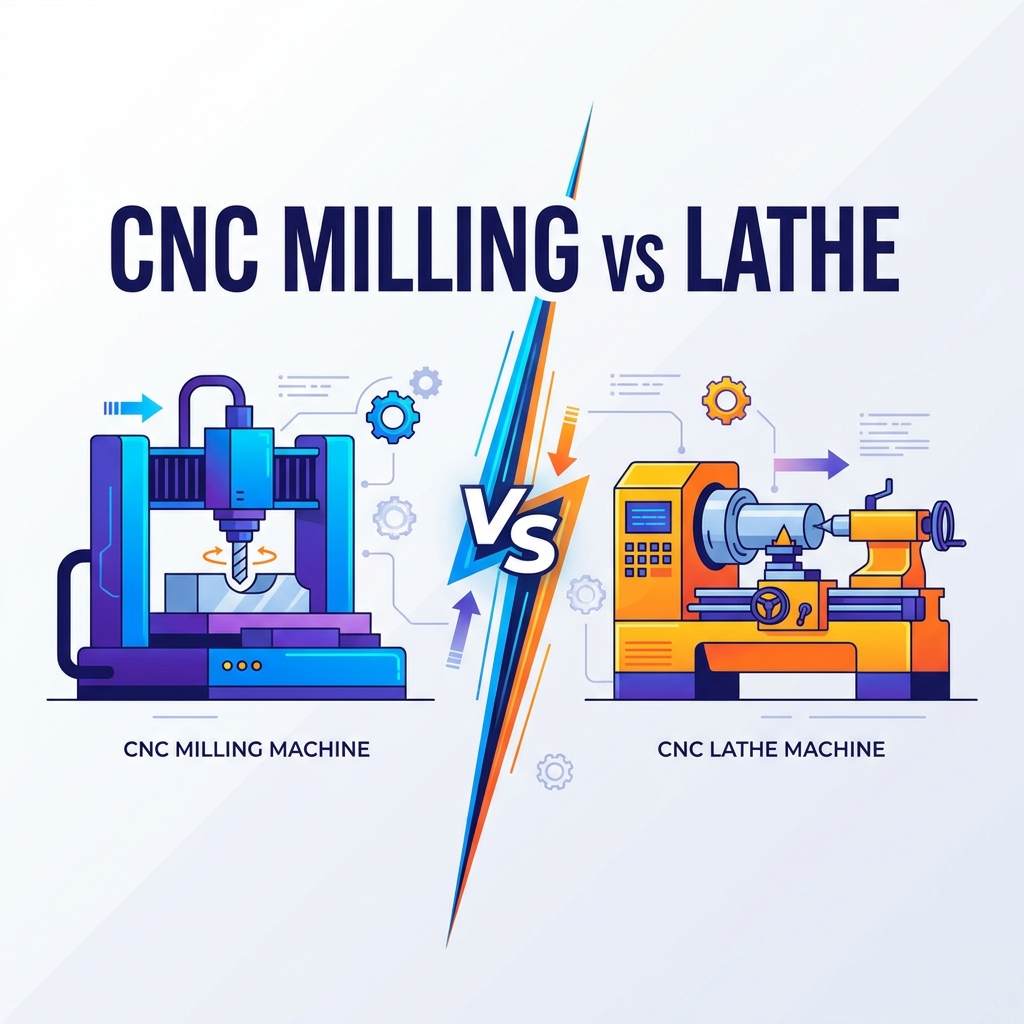 Compare CNC milling vs. turning. Learn differences in kinematics, geometry, cost, and automation to select the right machine for your production.Product news
